

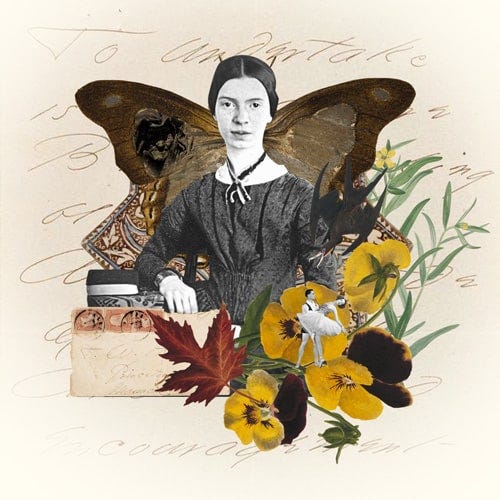
What’s the longest it’s ever taken you to finish a book? Weeks? Months? Years? I don’t have an answer yet, because I am still not finished with the book in question. I’ve been reading through the same Emily Dickinson collection for over five years, and I still have yet to reach the end.
Look, I’m a slow reader on a good day, but even I’m not this slow. I’ve been taking my sweet time on purpose, giving myself the chance to… digest? Metabolise? I want to find a word that means fully process her words, without sounding like I’m talking about my gut health. You get the idea.
I guess what I really mean is that I want to live with them. To write them down and hang them on my wall, talk them over with a friend, turn them over in my head. I say live with them both in a spiritual sense and a literal one – this book has travelled with me overseas, bounced between various living spaces, and migrated to pretty much every table, chair, or bedside in my home. When you live with a book that long, the author’s voice starts to seem like an old friend’s. The reading starts to feel like a conversation.
My book is now full of highlights and underlines, thoughts jotted down in the margins, and scribbled explanations of words I had to look up, or nature references that went over my head (seriously, what is a bobolink? Can I blame my ignorance on growing up in the Southern hemisphere?). Emily offers me new ways to look at the world around me, funny observations, poignant truths about life and death.
I don’t claim to understand her work perfectly (and honestly, the pressure to “get it right” turns a lot of people off reading poetry in general. That’s a soap box for another day). But many of her words have stuck with me, and given me food for thought or language for a particular feeling I didn’t have before. (Or they’re just plain delightful. That’s important too).
Out of all the Emily poems I’ve read so far, these are the ones that, for whatever reason, big or small, left an impression on me. And personally, I find my reading of a poem is so much more enjoyable when I get to talk about it with someone, so today, please imagine we’re sitting at a cosy fireplace, sipping your favourite hot drink, and reading these together. Emily Dickinson book club is in session…
1. I’m Nobody, Who Are You?
You’ve probably read this one before. It’s kind of a classic, and it feels more relevant now than ever. In an age where we feel so much pressure to be constantly visible, constantly climbing, constantly having Something to Say, it feels revolutionary to let yourself be unseen. In a world of “Somebodies”, there is a freedom in choosing to be “Nobody”. In the funniest way, this poem reminds me to get over myself, because at the end of the day, none of us are that special (and that’s a good thing!) Might as well take it from a talented poet who barely published anything in her lifetime and was often described as a “recluse”.
I’m Nobody! Who are you?
Are you - Nobody - too?
Then there’s a pair of us! – don’t tell!
They’d banish us, you know!
How dreary to be Somebody!
How public, like a Frog -
To tell your name the livelong day -
To an admiring Bog!
2. Autumn
I love the way Emily talks about the natural world as if it has a distinct personality. It can be cheeky, or cruel, or gentle, or passionate. I especially love how she has a poem for all kinds of different seasons, so no matter what time of year it is, I can find words to help me see the beauty in it. This one always makes me want to be a little extra fancy in the autumn.
The morns are meeker than they were,
The nuts are getting brown;
The berry’s cheek is plumper,
The rose is out of town.
The maple wears a gayer scarf,
The field a scarlet gown.
Lest I should be old-fashioned,
I’ll put a trinket on.
3. From the Chrysalis
I never hear anyone talk about this poem, but it’s one of my personal favourites. I love the idea of the butterfly as a metaphor for knowing you contain multitudes; that there is more within you than meets the eye, even if you can’t fully see it yet. “A dim capacity for wings”, as Emily so beautifully puts it. May we all someday find our “easy sweeps of sky.”
My cocoon tightens, colors tease,
I’m feeling for the air;
A dim capacity for wings
Degrades the dress I wear.
A power of butterfly must be
The aptitude to fly,
Meadows of majesty concedes
And easy sweeps of sky.
So I must baffle at the hint
And cipher at the sign,
And make much blunder, if at last
I take the clew divine.
4. There’s a Certain Slant of Light
This one does a great job capturing a very specific feeling – what L.M. Montgomery’s Emily of New Moon refers to as “the flash”, and C.S. Lewis called “joy”. Both describe a kind of bittersweet ache, often brought about by something so deeply beautiful that it makes you long for something beyond yourself:
“It had always seemed to Emily, ever since she could remember, that she was very, very near to a world of wonderful beauty. Between it and herself hung only a thin curtain; she could never draw the curtain aside-- but sometimes, just for a moment, a wind fluttered it and then it was as if she caught a glimpse of the enchanting realm beyond…” (L.M. Montgomery, Emily of New Moon)
It must be an Emily thing, because Ms. Dickinson also does a beautiful job describing that specific kind of “heavenly hurt” …
There’s a certain Slant of light,
Winter afternoons –
That oppresses, like the heft
Of Cathedral Tunes –
Heavenly Hurt, it gives us –
We can find no scar,
But internal difference –
Where the Meanings, are –
None may teach it – Any –
’Tis the seal Despair –
An imperial affliction
Sent us of the Air –
When it comes, the Landscape listens –
Shadows – hold their breath –
When it goes, ’tis like the Distance
On the look of Death –
5. If You Were Coming in the Fall
I have nothing particularly profound to say about this one, except that I think it’s unbelievably cute, and perfectly captures that sense of giddy impatience when you’re especially excited about seeing someone. And don’t we love a poet who can do both?
If you were coming in the Fall,
I’d brush the Summer by
With half a smile, and half a spurn,
As Housewives do, a Fly.
If I could see you in a year,
I’d wind the months in balls---
And put them each in separate Drawers,
Until their time befalls.
If only Centuries delayed,
I’d count them on my Hand,
Subtracting, till my fingers dropped
Into Van Dieman’s Land,
If certain, when this life was out---
That yours and mine, should be
I’d toss it yonder, like a Rind,
And taste Eternity---
But, now, uncertain of the length
Of time’s uncertain wing,
It goads me, like the Goblin Bee---
That will not state--- its sting.
6. I Had No Time to Hate
Another very beloved Emily Dickinson poem, and for good reason. It’s powerful in the simple statement it makes – that inevitably, we pour our energy into something all our lives, and it’s up to us what that is. Both hating and loving are hard and never-ending work, so we might as well choose the latter.
I had no time to Hate -
Because
The Grave would hinder me -
And Life was not so
Ample I
Could finish--Enmity -
Nor had I time to Love -
But since
Some Industry must be -
The little Toil of Love -
I thought
Was large enough for Me.
7. If I Can Stop One Heart From Breaking
In a very similar vein, this poem speaks to the way there is purpose in even the tiniest acts of love. I’ve found it to be very comforting on days where it’s hard to believe that my little drop in the bucket makes much of a difference.
If I can stop one Heart from breaking,
I shall not live in vain
If I can ease one Life the Aching,
Or cool one Pain,
Or help one fainting Robin
Unto his Nest again,
I shall not live in vain.
8. I Measure Every Grief I Meet
One of the most beautiful meditations on grief I’ve ever read. It ponders the idea that every person you meet is carrying their own pain, and even though you can guess what theirs is like, you can’t truly know just by looking at them. Sadness comes in different shades and different weights. The speaker has plenty of questions about grief – Can it be measured? Does it feel the same to everyone? Does it get lighter with time?
She doesn’t attempt to force easy answers to these questions, but reflects on how there is a strange comfort in knowing that we’re not alone in feeling grief. At some point in time it touches every person’s life. I find the comparison between a fake smile and a light running out of oil to be especially haunting.
I measure every Grief I meet
With narrow, probing, Eyes --
I wonder if It weighs like Mine --
Or has an Easier size.
I wonder if They bore it long --
Or did it just begin --
I could not tell the Date of Mine --
It feels so old a pain --
I wonder if it hurts to live --
And if They have to try --
And whether -- could They choose between --
It would not be -- to die --
I note that Some -- gone patient long --
At length, renew their smile --
An imitation of a Light
That has so little Oil --
I wonder if when Years have piled --
Some Thousands -- on the Harm --
That hurt them early -- such a lapse
Could give them any Balm --
Or would they go on aching still
Through Centuries of Nerve --
Enlightened to a larger Pain --
In Contrast with the Love --
The Grieved -- are many -- I am told --
There is the various Cause --
Death -- is but one -- and comes but once --
And only nails the eyes --
There’s Grief of Want -- and Grief of Cold --
A sort they call “Despair” --
There’s Banishment from native Eyes --
In sight of Native Air
And though I may not guess the kind --
Correctly -- yet to me
A piercing Comfort it affords
In passing Calvary --
To note the fashions -- of the Cross --
And how they’re mostly worn --
Still fascinated to presume
That Some -- are like My – Own
9. He Ate and Drank the Precious Words
Find me a more accurate description of the joys of being a bookworm. I’ll wait.
He ate and drank the precious words,
His spirit grew robust;
He knew no more that he was poor,
Nor that his frame was dust.
He danced along the dingy days,
And this bequest of wings
Was but a book. What liberty
A loosened spirit brings!
10. A Day
You find the first line of this poem quoted often, but the whole thing is worth your time. It’s another example of Emily’s gift for seeing the natural world in such a rich, animated way. Where anyone else might just see a sunrise or sunset, she sees a whole production full of distinct characters – the sunbeams like little children being called away, the hills untying their bonnets, the church steeples swimming in purple sky. It always inspires me to pay deeper attention.
I’ll tell you how the Sun rose –
A Ribbon at a time –
The Steeples swam in Amethyst –
The news, like Squirrels, ran –
The Hills untied their Bonnets –
The Bobolinks – begun –
Then I said softly to myself –
“That must have been the Sun”!
But how he set – I know not –
There seemed a purple stile
That little Yellow boys and girls
Were climbing all the while –
Till when they reached the other side –
A Dominie in Gray –
Put gently up the evening Bars –
And led the flock away –
11. Have You Got a Brook
I love this one. It feels so delicately whimsical, though I’m still not sure if I’ve fully grasped the meaning (I might need to put it on my wall and ponder some more). The way I read it, it feels like it’s about a person’s inner world, and how that world goes through seasons. Times of feeling bright and blooming, times of dryness and depletion. It feels like a gentle reminder to keep watch over the little brook of your heart, tend to it and notice when it’s in danger of overflowing or drying up. Honestly, it’s not bad advice. Emily might have made a good therapist.
Have you got a Brook in your little heart,
Where bashful flowers blow,
And blushing birds go down to drink,
And shadows tremble so—
And nobody knows, so still it flows,
That any brook is there,
And yet your little draught of life
Is daily drunken there—
Why, look out for the little brook in March,
When the rivers overflow,
And the snows come hurrying from the fills,
And the bridges often go—
And later, in August it may be—
When the meadows parching lie,
Beware, lest this little brook of life,
Some burning noon go dry!
12. Hope
Cliché or not, I couldn’t really talk about Emily Dickinson without talking about “hope is the thing with feathers”. The idea of hope as a small bird that always goes on singing is a simple but powerful image that has stood the test of time for a reason.
Referencing this poem, author John Green once noted, “Emily Dickinson doesn’t say that one never stops hearing the Song of Hope, only that it doesn’t stop playing.” It’s a comforting thought; that the presence of hope isn’t determined by whether or not I feel hopeful. Emily paints a picture of Hope as both unassuming and unflappable (bird pun absolutely intended).
I’ve spent a lot of time thinking about this one. The line about feathers and singing is what tends to stick in our heads, but I often come back to the last line: “Yet, never, in extremity, it asked a crumb of me.” This used to puzzle me. Does hope really not ask anything of us? I’ve wondered about it for a while.
Maybe what Emily is saying is that the feeling of hope is not always present, but the reality of it is. When we can’t hold onto Hope, it does not ask us to. Hope, in a sense, holds onto us.
“Hope” is the thing with feathers -
That perches in the soul -
And sings the tune without the words -
And never stops - at all -
And sweetest - in the Gale - is heard -
And sore must be the storm -
That could abash the little Bird
That kept so many warm -
I’ve heard it in the chillest land -
And on the strangest Sea -
Yet - never - in Extremity,
It asked a crumb - of me.
Are there any I missed that deserve a spot on this list? I would love to know!
Goodnight, Dear Void <3
Me, upon seeing your title: do I even call myself a reader?! I don't know ANY Dickinson poems!!
Thank the Lord for this post so I can catch up and sound like I've been reading her all my life because now I can cross-reference L.M. Montgomery and Lewis with one of her poems... you are doing the Lord's work here.
So many of these poems I had never read before! The one about grief and ending it with Calvary was beautiful. Sometimes I just sit in amazement at the words people find to express what they're trying to say.